
Every card payment may look like a completed sale, but part of that revenue disappears before it reaches your bank account. For retailers processing hundreds of transactions daily, credit card processing fees can quietly drain thousands of dollars each year. A cash discount Point of Sale System provides customers with a discount if they pay in cash, and a dual pricing POS shows customers two different price tags, one for cash and one for card. Both the two options provide margin protection for retailers while preserving the payment convenience that customers expect. This article explains the concept of cash discount, its legalities, savings benefit, and how POS makes it easy to put it into practice.
What Is a Cash Discount Program?
A cash discount program rewards customers who pay with cash instead of a credit card. Retail businesses set their regular posted prices to cover credit card acceptance costs and offer a lower price to customers who pay with cash. Businesses may apply the discount as a fixed amount or a percentage. When they configure the program correctly, customers receive genuine savings instead of facing an unexpected card fee at checkout.
How Dual Pricing Works at the Point of Sale
Dual pricing gives customers a clear choice by showing the cash price and card price before they complete the purchase.
- Two prices are established: Each eligible product/service is available for a lower cash price and a regular card price, which takes into account the fees of accepting electronic payment.
- Prices appear clearly: Customers will be able to view both amounts on the shelf labels, menu boards, customer-facing displays, invoices and other pricing materials.
- The payment method is selected: The cashier selects from cash, credit card, debit card and other payment options when checking out.
- The correct total is calculated: The POS applies the cash price when a customer pays with cash and the card price when an eligible card is used.
Cash Discount vs. Dual Pricing – What’s the Difference?
Both models protect business margins, but they present prices and savings to customers in slightly different ways.
Pricing Structure
The cash discount program begins with one regular posted price. Discounts are offered to customers who pay in cash. In dual pricing, the two charges are shown from the start, one for cash and the other for card. Both can have the same financial impact, but the customer interprets the pricing in a different way.
Transaction Fee Handling
Cash discounting includes card processing costs in the normal price, and then gives a lower price when customers pay with cash. Dual pricing shows two different prices: one for cash and one for card. The business still pays the card processor, but the higher card price helps cover those fees.
Customer Focus
Cash discounting is about rewarding a preferred customer behavior. The message is simple: Pay cash and save. Dual pricing is more about the choice of payment. The two amounts are shown, and the customer can make a choice about whether they want to pay the regular card fee or the lower discounted fee at the cost of card convenience.
Customer Savings
Customers save money under both structures when they select cash. With cash discounting, the savings appear as a discount from the regular price. With dual pricing, the savings are visible through the difference between the listed cash and card amounts. Clear presentation makes the benefit easier to understand.
Which Businesses Benefit Most from Cash Discount POS?
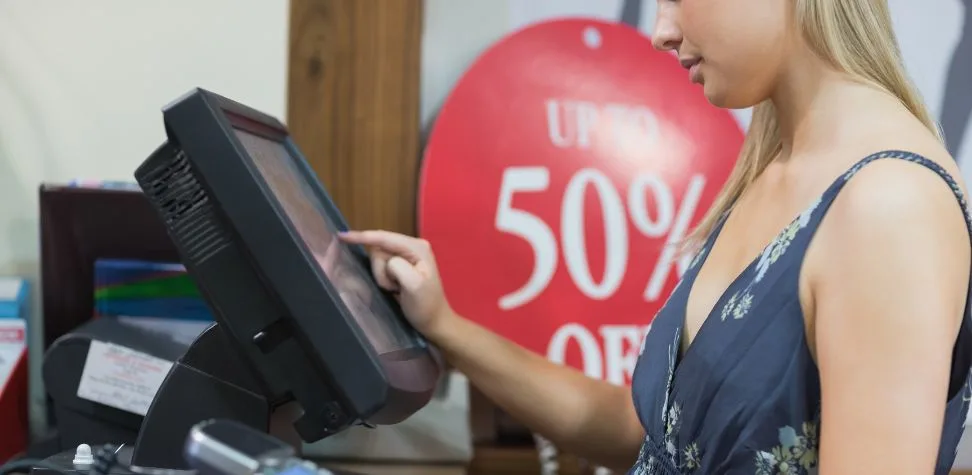
Cash discount POS benefits those businesses where sales require face-to-face interaction, margin is tight and card usage is high. Most of the transactions at convenience stores, liquor stores, grocery stores, tobacco stores, restaurants, salons, repair shops, meat markets, supermarkets and independent stores accumulate fast, where even a small card fee gets added quickly.
Other service-based businesses, like electricians, landscapers, auto repair shops, and contractors may benefit, too, as they tend to have higher average transaction values.
Is Cash Discounting Legal in the United States?
Yes, cash discounting is permitted in 50 US states, provided it is structured as a genuine reduction from the regular price and follows federal, state, processor, and card-network requirements.
- The discount must reduce the regular price: The federal law makes a distinction between a discount and surcharge. A discount is reducing the regular price and a surcharge is raising the regular price for a cardholder, which is illegal.
- Disclosure should be clear: Signs, shelf labels, menu boards and customer displays should tell the customer the prices available before they pay, and receipts should identify the pricing options. Complaints and compliance issues can arise from hidden adjustments at the register.
- State requirements must still be checked: Merchants also should ensure that state law, and local rules are up to date before launch. For instance, in Wyoming, qualifying cash discounts are capped at 5% and must be disclosed.
What to Look for in a Cash Discount POS System
Below are the most important features to consider before selecting a cash discount POS system for your business.
Compatibility With Your POS System
Verify smooth integration with your existing payment terminal, payment processor, receipt printer, scanner, and back office software. A compatible cash discount POS should calculate the correct cash discount automatically without duplicate data entry, disconnected devices, or manual fee calculations that slow down checkout and create errors.
Easy to Use and Implement
The system should be easy to install, configure, and test. Managers must be able to set the cash discount percentage, define the cash discount rules, and update pricing without technical confusion. Cashiers should require minimal training to apply the cash discount at checkout, explain the cash savings to customers, correct mistakes, and produce clear customer receipts showing the discounted cash price.
Reliable Customer Service and Support
Payment problems can stop sales immediately, so dependable support matters. Look for responsive assistance during installation, staff training, pricing configuration, terminal setup, reporting, and troubleshooting. The provider should also help review settings when payment rules or business requirements change, rather than leaving the merchant to solve problems alone.
How Gokul POS Makes Cash Discount Setup Simple?
Gokul POS combines cash discount and dual-pricing features with an accessible dashboard, customizable displays, digital receipts, real-time reporting, and technical support.
Determine the Discount Amount
The first step is to check out your processor statements and determine your effective card acceptance cost. Take into account percentage fees, transaction fees, card types, average ticket size, current margins, etc. After that, our POS system can be set up to offer an appropriate discount that will allow for cost savings without making the payment options unreasonable.
Update Your Pricing Strategy
The chosen program requires your normal pricing. So, before altering the prices, check the product cost, taxes, markup, competitor pricing, and customer expectations. Our POS includes cash discount and dual pricing features, enabling your business to offer choices regarding payment without having staff members manually compute the different totals for each transaction.
Provide Clear Communication and Signage About The Payment Option
Place easily readable signs at entrances, product displays, registers, menu boards and payment stations. Staff should remind customers that if they opt for cash, they will be charged less. Our POS system can also provide customizable displays and receipt options, which aid in clear communication and allow customers to view available prices before making a purchase.
Real Savings – How Much Can Your Business Keep?
Imagine a retailer who has 3% fees on their average card sale and pockets $60,000 per month. This translates to $1,800 in credit card processing fees per month, or $21,600 a year. If a well-designed program recovers or saves 80% of that cost, the business could be keeping $17,280 more annually.
However, actual savings will vary based on the card mix, processor pricing, transaction size, cash adoption, refunds, chargebacks and program costs. Partial recovery can include buying inventory, paying employees’ salaries, making repairs, advertising, or covering one month of operating costs.
Common Concerns Business Owners Have (And the Honest Answers)
Most concerns can be addressed through transparent pricing, trained employees, proper configuration, and a customer-friendly rollout.
- Will customers complain?
There may be questions raised at first. But clear signs and a simple explanation usually prevent frustration. When the cash saving is visible before checkout, customers are more receptive.
- Will card customers leave?
Most customers value convenience and may continue using cards. The goal is not to remove card payments. It is to let customers choose while protecting the merchant’s margin.
- Will checkout become slower?
Not with a reliable POS system that is configured properly. This is because the POS automatically calculates the applicable price after the cashier chooses the payment method, thus eliminating mental calculation and manual adjustment.
- Is this the same as adding a hidden surcharge?
No. A genuine cash discount lowers the regular price for cash buyers. However, incorrect pricing or poor disclosure can make a program resemble an improper surcharge.
Ready to Stop Paying Credit Card Fees Out of Your Profits?
Accepting cards should drive your sales, not quietly eat into your profits for every sale. Gokul POS provides practical solutions for retailers to display cash/credit prices, offer discounts, create clear receipts, track sales and manage daily operations from a single POS system. With us, you can provide payment flexibility to consumers, while getting a greater sense of control over your processing costs. Request a POS Demo today and see how transparent payment pricing could strengthen your margins, simplify checkout, and return more revenue to your business.

Founder & CEO of Gokul System Solutions: Based in Schaumburg, Illinois, he leads a company providing Point of Sale (POS) and payment solutions for retail industries in the USA, Canada, UK, and India.